High flexibility even at extreme ambient temperatures
Silicones respectively silicone rubbers belong to the class of elastomers, but differ in the fact that the main chain is not composed of carbon compounds, but of alternating silicium and oxygen atoms. The silicium atoms carry organic substituents, preferably methyl groups.
Silicones or silicone rubbers belong to the class of elastomers, but differ in that the main chain is not composed of carbon compounds, but of alternating silicon and oxygen atoms. The silicon atoms carry organic substituents, preferably methyl groups.
Silicones are chemically crosslinked and as a result form a network structure. The inorganic polymer chain of silicon and oxygen has a greater binding energy, which means that the properties are significantly stronger than those of purely organic elastomers.
Operating temperatures of 180 °C long-term or 200 °C for short-term use are therefore possible.
Typical Areas of Application for Silicone are:
Power cables (high voltage/control cables/wind power)
Railroad cables
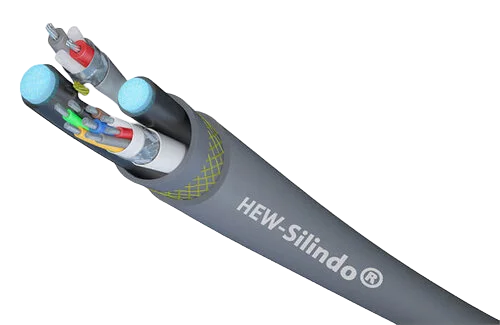
Medical cables (HEW Silindo®)
Military cables (Navy/Air Force)
Heating cables
LV-216 cables and
Nuclear lines (AKW)
Manufacturing Competencies Silicone
Depending on their molar mass, silicone rubbers can be divided into liquid silicones (LSR) and solid silicones (HTV), resulting in different processing methods.
Solid silicones are copolymers of dimethylsiloxanes (main chain) and isolated vinylmethylsiloxanes (functional group). Due to their low intermolecular interaction, they have a soft, pasty consistency. With a viscosity of 10,000 to 50,000 Pa-s, solid silicones are easy to process at room temperature.
Liquid silicones are usually 2-component systems consisting of the platinum catalyst (component A) and the Si-H crosslinker (component B), which are crosslinked exclusively by addition. Due to short-chain linear polysiloxanes with a viscosity of approx. 5-500 Pa-s and a relatively low filler content (max. 30%), liquid silicones have a pourable to pasty consistency and are mainly processed by injection molding.