Insulation and sheathing materials
When designing the best possible cable for the customer, choosing the right insulation and sheathing material is a key factor.
Insulation and sheath are the plastic components of a cable that protect the conductor. The insulation isolates the flow of electricity, and the sheath wraps around the outside of the cable to protect the conductors inside and enable electricity transmission.
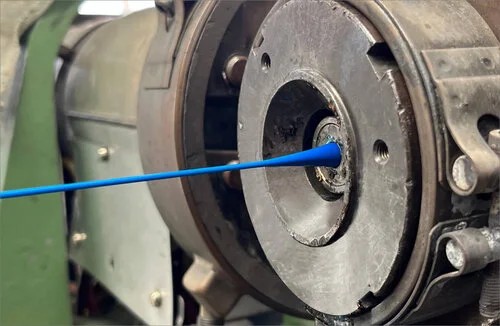
The choice of material used for insulation and sheath can have a significant impact on the overall performance of a cable, and there are a number of key factors to consider when choosing the right material for your application:
Fluoropolymers are long-chain polymers in which a large proportion or even all of the hydrogens contained are replaced by fluorine. Fluorine atoms have the highest electro negativity, which means that the carbon-fluorine compound has a very high binding energy.
Elastomers are long-chain polymers that have thermoplastic properties in the uncombined state. They become soft with rising temperature and are thus extrudable. Only through vulcanization (crosslinking) is a narrow- or wide-meshed structure formed.
Silicones respectively silicone rubbers belong to the class of elastomers, but differ in the fact that the main chain is not composed of carbon compounds, but of alternating silicium and oxygen atoms. The silicium atoms carry organic substituents, preferably methyl groups.
High-performance thermoplastics (special thermoplastics) differ from "simple plastics" in their complex polymer structure. They consist of aromatic structures and additional functional groups, such as ether or imide groups.
Thermoplastic elastomers (TPE) combine the properties of thermoplastics and elastomers. For example, TPE exhibits elastic behavior at room temperature, but can be plastically deformed when heat is applied.
Tapes, or binders, and fillers are applied to improve flexibility or roundness of the cable, to protect the insulation or sheath, or to ease production.
When designing the best possible cable for the customer, choosing the right insulation and sheathing material is a key factor.
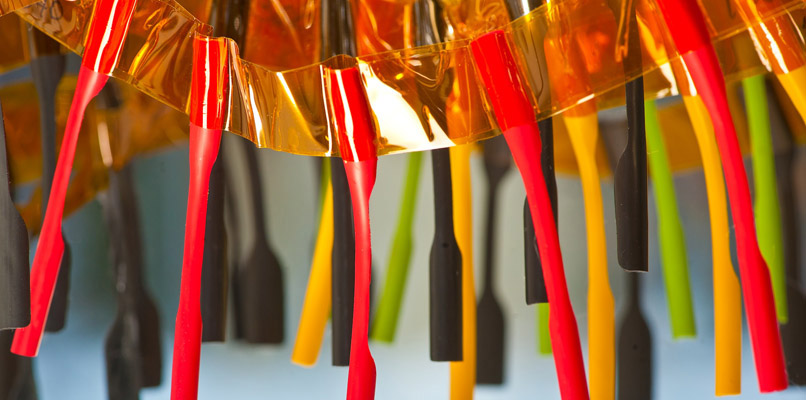
After over 80 years in the business, we’re experts in finding the perfect combination of cable materials and components to create the best solution for you. Explore the key components and common material choices below.